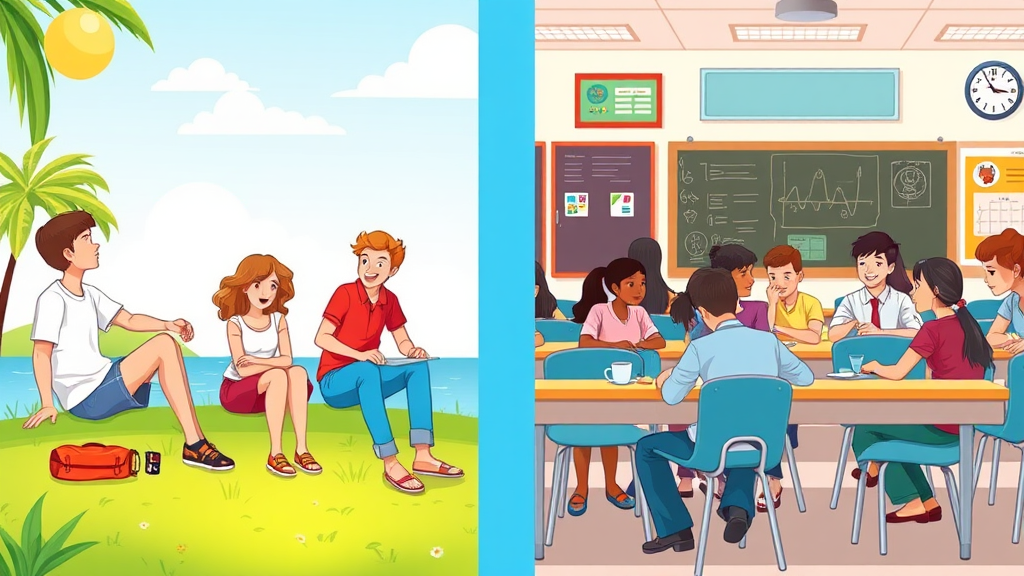
Should the Summer Holiday Be Shorter?
Every August the same argument returns: students forget what they learned over ten weeks off, but shorter holidays mean tired teenagers and no family time. Where do you stand?
1. Reading: The Ten-Week Question
Read the text. Which side sounds stronger to you?
Every August the same argument returns: should the school summer holiday be shorter? Supporters of change point to the "summer slide". Studies show that many students forget some of what they learned, especially in maths and reading, after ten weeks away from school. Teachers then spend most of September helping everyone catch up. Supporters also note that several countries with shorter summer breaks, such as Germany and Denmark, often score well in international tests.
On the other side, many families argue that teenagers need a real rest. School years are long and stressful, and by July many students are simply exhausted. A long break gives families time to travel together, and it lets older students take summer jobs, learn new skills, or spend time on hobbies. There is little clear evidence that a few extra weeks of lessons would improve results.
Perhaps the answer is a compromise: a slightly shorter summer, with longer breaks during the school year instead.
2. Vocabulary: Talking About Opinions
Match each word from the text with its definition.
- argue
- benefit
- drawback
- balance
- exhausted
- catch up
- evidence
- compromise
- to give reasons why you think something is right or wrong
- a good or helpful result of something
- a disadvantage or negative side of something
- a situation where two things get equal, fair attention
- extremely tired
- to reach the level of others after falling behind
- facts or information that show something is true
- an agreement where each side accepts a little less than it wanted
3. Comprehension Check
Answer the questions about the text.
1. What is the "summer slide"?
- A popular water activity at summer camps
- Forgetting part of what was learned during the long break
- The drop in temperature at the end of August
2. Which subjects does the text say suffer most?
- History and geography
- Art and music
- Maths and reading
3. According to the text, what do teachers do in September?
- They spend most of the month helping students catch up
- They give students extra holidays
- They start new topics immediately
True or false? Choose the right option.
4. Germany and Denmark are examples of countries with shorter summer breaks.
- True
- False
5. The text says a long break stops older students from taking summer jobs.
- True
- False
6. According to the text, there is strong evidence that extra weeks of lessons improve results.
- True
- False
4. Gap-Fill: Use the New Words
Complete the sentences with words from Exercise 2.
Word bank: argue · benefit · drawback · balance · exhausted · catch up · evidence · compromise
1. Many parents ______ that teenagers need a proper rest after a stressful year.
2. One clear ______ of a long holiday is time for family travel.
3. The biggest ______ of a ten-week break is that students forget what they learned.
4. Schools need to find a ______ between study and rest.
5. By the end of the exam season, most students feel completely ______ .
6. In September, teachers help their classes ______ (two words) on forgotten material.
7. There is little ______ that longer school years always produce better results.
8. A shorter summer with longer breaks in autumn could be a fair ______ .
5. Agreeing and Disagreeing
You will need these phrases for the discussion. Choose the best option for each situation.
1. Which phrase shows strong agreement?
- I'm not so sure about that.
- Absolutely, I couldn't agree more.
- That's a fair point, but I disagree.
2. Which phrase disagrees politely?
- I see what you mean, but I look at it differently.
- That's completely wrong.
- Exactly! You're so right.
3. Your partner makes a point you only partly agree with. What do you say?
- No way, forget it.
- I completely agree with everything.
- You have a point, but there's another side to this.
4. Which phrase invites someone into the discussion?
- Where do you stand on this?
- Let's talk about something else.
- I'd rather not hear your opinion.
6. For or Against?
Sort the arguments into the correct column.
For a shorter holiday · Against a shorter holiday
- Students forget less over the break
- Teenagers need a real rest after a stressful year
- Teachers spend less of September revising old material
- Families get time to travel together
- Countries with shorter breaks often score well in tests
- Older students can take summer jobs
- Learning stays fresh through the whole year
- There is time for hobbies and new skills
7. Discussion
In pairs or small groups, discuss the questions below. Use the phrases from Exercise 5.
1. How do you usually spend your summer holiday? Do you ever feel the "summer slide" yourself?
2. Would you trade two weeks of summer for longer breaks in autumn and spring? Why or why not?
3. Who should decide the length of the school holiday: the government, schools, parents, or students?
4. Imagine the summer holiday became only four weeks long. What would change for you and your family?
8. Class Debate

Split the class into two teams. Team A argues for a shorter summer holiday, Team B argues against. Each team gets five minutes to prepare, then each speaker has one minute. Finish with a class vote: did anyone change their mind?
Before the debate, note your team's two strongest arguments and one argument you expect from the other team.
This lesson is interactive: open this page in a browser to fill in the answers and get them checked automatically. Teachers can copy the lesson and edit every part of it.