Are Esports Real Sports?
Competitive gaming now fills arenas, pays salaries and runs training camps, yet the argument about whether it belongs beside athletics is still unsettled. In this lesson you will read both sides, learn the key vocabulary, practise the language of polite disagreement and then debate the question yourselves.
Reading: Game On?
Read the text once for general meaning, then again more carefully. You will need it for Exercises 2 and 5.
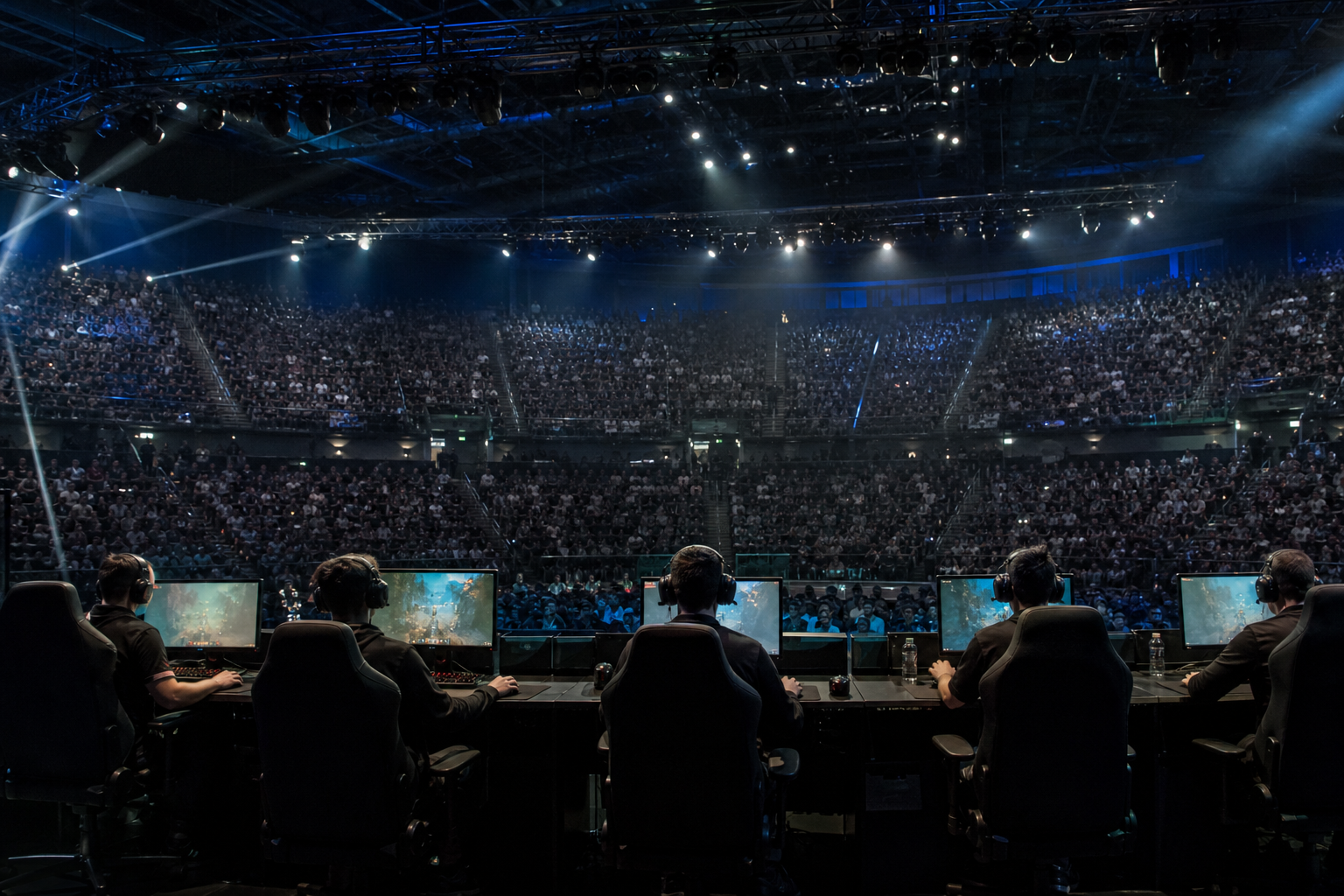
When 40,000 spectators fill a stadium to watch a final, you might expect football or basketball. Increasingly, however, the crowd has come for a video game. Professional gaming, known as esports, now offers salaries, sponsors and prize money that rival traditional sport, and the question of whether it deserves the same recognition divides opinion.
Supporters point out that top players are far from casual gamers. They follow strict training regimes, practising up to ten hours a day, and their reflexes are measured in milliseconds: faster, some studies suggest, than those of table-tennis players. Team houses employ coaches, analysts and even nutritionists, and tournaments demand the mental endurance of a chess championship.
Critics accept the skill involved but argue that sport requires physical exertion: a competition won while sitting in a chair, they say, is a game, not a sport. Others worry about commercial pressure, since the companies that own the games also run the tournaments, deciding who competes and under what rules.
For now, the argument remains unsettled. Some countries grant players athlete visas; the Olympic movement still keeps esports at arm's length. Whatever the answer, the arenas keep selling out.
Exercise 1 · Topic Vocabulary
Match each word from the text with its definition.
- competitive
- tournament
- reflexes
- endurance
- sponsor
- prize money
- spectator
- professional
- training
- recognition
- involving a strong desire to win or to be more successful than others
- a series of matches in which players compete until one winner remains
- the ability to react very quickly, without conscious thought
- the power to keep going through a long or difficult effort
- a company that pays to support an event or team, usually for advertising
- cash awarded to the winners of a competition
- a person who watches an event without taking part in it
- doing an activity as a paid job rather than as a hobby
- regular practice done to improve skill or fitness
- public acceptance that something is real, official or valuable
Exercise 2 · Comprehension
Choose the best answer according to the text. Questions 5 and 6 are not answered directly: you will need to read between the lines.
1. Why does the writer mention the 40,000 spectators at the start?
- to show how expensive the tickets have become
- to show that esports now attract crowds like traditional sport
- to prove that football is losing its fans
- to explain why so many stadiums were built
2. According to the text, what do top players' training regimes include?
- up to ten hours of practice a day
- mostly physical fitness sessions
- a few casual games each evening
- daily chess championships
3. What does the text say about players' reflexes?
- They are slower than those of table-tennis players.
- They cannot be measured accurately.
- Some studies suggest they beat those of table-tennis players.
- They matter less than physical strength.
4. What is the critics' main argument?
- Esports players earn too much money.
- An activity without physical exertion is not a sport.
- Video games are harmful to health.
- Esports tournaments last too long.
5. Why does the ownership of the games worry some people?
- Companies could shape competitions to suit their own business.
- Companies refuse to pay the prize money they promise.
- The games have become too expensive to buy.
- Players change teams too often during a season.
6. What can we infer about official attitudes to esports?
- Every country now treats esports players as athletes.
- The Olympic movement has fully accepted esports.
- Institutions disagree, so recognition is still only partial.
- Most governments plan to ban large tournaments.
Exercise 3 · Use the New Vocabulary
Complete each sentence with one item from the word bank. Use each item once.
Word bank: competitive · tournament · reflexes · endurance · sponsor · prize money · spectator · professional · training · recognition
1. The final was so ______ that the lead changed five times in one match.
2. Sixteen teams entered the ______ , but only one lifted the trophy.
3. Goalkeepers need sharp ______ to stop shots they barely see.
4. A five-hour final tests a player's mental ______ as much as their skill.
5. The team found a new ______ to pay for travel and equipment.
6. The winners shared one million dollars in ______ .
7. Every ______ in the arena stood up when the champions appeared.
8. She gave up her office job to become a ______ player.
9. His daily ______ includes two hours of aim practice before breakfast.
10. Chess gained official ______ as a sport in many countries years ago.
Exercise 4 · Conceding a Point and Countering
In a good discussion you often accept part of the other side's argument before you answer it. Study the four phrases:
Admittedly, ... = you accept a point is true before giving your own argument.
That said, ... = "even so": you accept the point, then move to the opposite side.
up to a point = only partly: "I agree with you up to a point."
On the contrary, ... = the opposite of what was said is true.
Choose the phrase that completes each sentence naturally.
1.
- Admittedly
- On the contrary
- Up to a point
- For example
2. Esports finals are certainly dramatic.
- That said
- On the contrary
- For example
- Up to a point
3. I agree with you
- on the contrary
- up to a point
- that said
- admittedly
4. You call the players lazy?
- Admittedly
- Up to a point
- On the contrary
- That said
5.
- On the contrary
- Admittedly
- Up to a point
- In other words
6. Reaction time matters in tennis too.
- On the contrary
- For example
- That said
- Up to a point
Exercise 5 · For or Against?
Drag each argument from the debate into the correct column.
For: esports are real sports · Against: esports are not sports
- Players follow strict daily training regimes
- Players compete while sitting in a chair
- Reaction times rival those of traditional athletes
- Very little physical exertion is involved
- Tournaments fill arenas and pay professional salaries
- Game publishers control the rules and the competitions
- Teams employ coaches, analysts and nutritionists
- Commercial interests may outweigh sporting values
Exercise 6 · Discussion
Work in pairs or small groups. Give reasons for your opinions and use the phrases from Exercise 4 when you disagree.
- In pairs: Would you buy a ticket to watch an esports final live in an arena? Why or why not?
- In small groups: Which matters more in sport, the body or the mind? Try to agree on one group answer.
- Debate in fours: Should schools accept esports as an official after-school activity, like football or athletics? Two of you argue for, two against.
- In small groups: Your country's Olympic committee asks your group for advice: should esports join the Games? Prepare a one-minute recommendation.
- In pairs: Disagree politely about this statement: "In twenty years, esports will be bigger than football." Use admittedly, that said, up to a point and on the contrary.
After your discussion, write your group's final verdict in two or three sentences.
This lesson is interactive: open this page in a browser to fill in the answers and get them checked automatically. Teachers can copy the lesson and edit every part of it.