B1 Reading and Vocabulary · Homework
Saturn at Its Brightest: Opposition Night
On 4 October 2026 Saturn reaches opposition, its closest and brightest night of the year. Read the text, learn the vocabulary and complete the exercises on your own. Your answers are checked automatically, so you can submit when you finish.
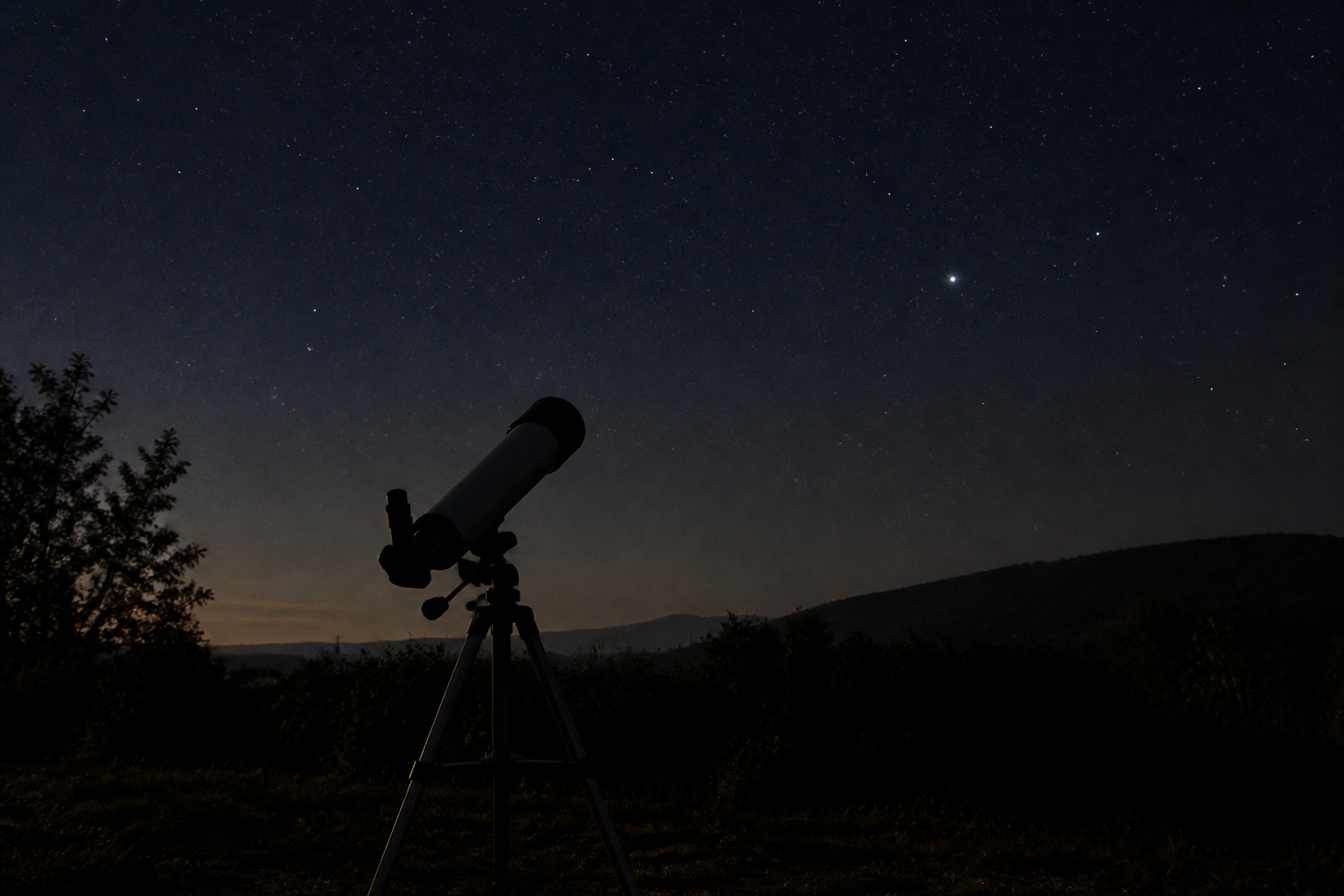
Reading: A Night to Watch Saturn
On the night of 4 October 2026, Saturn will reach opposition. This means that Earth passes directly between Saturn and the Sun, so the three bodies form a straight line. At opposition, Saturn rises at sunset and sets at sunrise, so it stays in the sky all night.
Saturn also looks brighter than usual. There are two reasons. First, the planet is closer to Earth than at any other time of the year. Second, its icy rings reflect more sunlight straight back to us. Saturn does not make its own light; like the Moon, it only reflects the light of the Sun.
You do not need an expensive telescope to enjoy the show. Saturn looks like a bright yellow star, and even a small telescope shows its famous rings and Titan, its largest moon. Find a dark place away from city lights, look east after sunset, and follow the planet as it slowly crosses the sky on its long orbit.
Exercise 1: Key Vocabulary
Match each astronomy word with its definition.
- orbit
- opposition
- ring
- telescope
- brightness
- surface
- moon
- reflect
- the path a planet follows around the Sun
- the moment when Earth stands exactly between a planet and the Sun
- a wide circle of ice and rock around a planet
- an instrument that makes distant objects look bigger
- how much light something sends to our eyes
- the outside or top layer of something
- a natural object that travels around a planet
- to send light back without making it
Exercise 2: Comprehension Questions
Read the text again and choose the correct answer for each question.
1. What does "opposition" mean in the text?
- Saturn passes between Earth and the Sun
- Earth passes directly between Saturn and the Sun
- The Sun passes between Earth and Saturn
- Saturn and Earth move away from each other
2. How long will Saturn stay visible on the night of 4 October?
- Only for one hour after sunset
- Until midnight
- From sunset to sunrise
- Only in the early morning
3. Why does Saturn look brighter at opposition? Choose one reason from the text.
- It burns more gas than usual
- It moves faster across the sky
- The Sun shines more strongly in October
- It is closer to Earth than at any other time of the year
4. Where does Saturn's light really come from?
- The planet produces it, like a star
- It reflects the light of the Sun
- It comes from its moon Titan
- It comes from city lights on Earth
5. What can you see with a small telescope?
- Only a yellow point of light
- The surface of the Sun
- Saturn's rings and its largest moon
- All of Saturn's moons at the same time
6. What is the best place to watch Saturn?
- A bright city square
- A dark place away from city lights
- Indoors, next to a window
- A place with many street lamps
Exercise 3: True or False?
Drag each statement into the correct column.
True · False
- At opposition, the Sun, Earth and Saturn form a straight line.
- Saturn is visible for only one hour on 4 October.
- Saturn makes its own light, like the Sun.
- Titan is Saturn's largest moon.
- You need a very expensive telescope to see the rings.
- A dark sky makes it easier to see the planet.
Exercise 4: Complete the Sentences
Type one word from the box in each gap.
orbit · opposition · rings · telescope · brightness · surface · moon · reflect
1. A planet travels around the Sun on a long path called an ______ .
2. When Earth stands exactly between a planet and the Sun, astronomers call it ______ .
3. Saturn's famous ______ are made of pieces of ice and rock.
4. With a small ______ you can see the rings clearly.
5. At opposition, the planet's ______ is at its highest.
6. Titan is Saturn's largest ______ .
7. Planets do not make their own light; they only ______ the light of the Sun.
8. Sunlight bounces off the icy ______ of the rings and travels back to Earth.
Exercise 5: Your Turn to Write
Would you like to look through a telescope? Write 60-80 words about what you would want to see in the night sky and why.
This lesson is interactive: open this page in a browser to fill in the answers and get them checked automatically. Teachers can copy the lesson and edit every part of it.